Friday, November 14, 2014

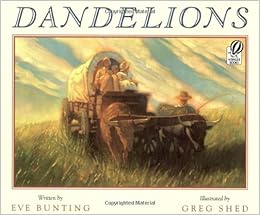
Dandelions

In this story, a pioneer father moves pregnant wife and family west from Minnesota, hoping for new opportunities and ready land.  Loneliness and isolation set in right away.  There are no trees and the grass closes behind them as they roll through miles upon miles in this sea of prairie.  "It's as if we'd never been here", said Mama, forlornly.  Their homestead site has no water, no flowers, no birds' song, and the nearest neighbors are three hours away.  Papa reassures, "It will be different soon.  Other settlers will come."

But as beetles and snakes plunge from the roof of their "soddie" onto their table, this far off hope was hard to imagine, especially for Mama and Zoe, the eldest daughter and narrator.  Then one day as Papa and Zoe set off for supplies, they stumble upon a symbolic clump of dandelions, probably brought west by other settlers.  They dig up a dandelion and transplant it on the roof of their sod house.  Though the story ends with this transplanted clump looking dry and lifeless there is the expectant hope that like the seeds that lie latent, the family's life will soon bloom into color and happiness.  But to get to this point it will take time.  "Can you wait?" Zoe asked her mother... "I can wait," Mama said.

Though the closing words end in waiting hope, the last picture shows a hazy, dreamlike view of their farm in the future, dandelions covering the roof and the fields plowed and fertile.

Discussion:

Good things are worth waiting for and working for.   Student writing focused on the ways that we wait and work patiently for the goods we pursue.  Improving your reading, writing, math fluency, athletic skills, etc. all take a lot of work and patience.  As we wait, we can find symbols of beauty and hope in simple, common things.

This was a great introduction to the challenges of the western movement and the lives of pioneers.  To extend this learning, students read about life in sod houses.

Links:

http://amhistory.si.edu/ourstory/activities/sodhouse/more.html
http://www.nebraskastudies.org/0500/frameset_reset.html?http://www.nebraskastudies.org/0500/stories/0501_0109.html

Thursday, November 13, 2014

The Sparrow Girl

http://fatfinch.files.wordpress.com/2008/07/sparrow-slingshot.jpg
In 1958, China’s Chairman Mao declared war on sparrows.  This was part of his "Four Pests" campaign.  He blamed them for devouring the nation’s wheat crop, and he required all citizens, armed with pots and pans and firecrackers, to take to the streets and literally scare the birds to death.  The “war” was a success insofar as the sparrows were eradicated.  However, Mao did not think through the ecological ramifications of his actions.  Having disrupted the food chain, these actions brought on a plague of locusts and a three-year famine that resulted in the deaths of almost 40 million Chinese. 

In this story, Sara Pennypacker uses these events as the backdrop for her fictional story about Ming-Li.  This small, seemingly “insignificant” girl feel badly for the sparrows under attack.  She secretly decides to disobey her leader, and rescues seven birds as they fall from the sky.  She nurses them back to health for several months, hiding them in a barn.   Finally, she finds the bravery to show these illegal birds to the farmers, whose crops are now suffering.  The book shows how one person, no matter how small, can make a difference.


In class discussion, we talked about cause and effect.  This story is the perfect example of C/E.

Social Studies connections

 Watch:

Students gave examples of peer pressure in their lives.  We discussed:
  • why many people conform to certain behaviors
  • how conformity or peer pressure among adults differs from peer pressure among children
  • whether it's human nature to conform
  • how television and advertisements try to encourage certain behavior
Watch:
https://www.youtube.com/watch?v=4srwSkD05ws&safe=active

 Discuss:  What were the Chinese government's strategies to promote conformity among young people?


Science connections
  • Students researched and drew the food chain of a sparrow. Then they researched the food chain of another animal of their choosing
  • After researching this second animal, students tried to imagine it taken out of the environment.  What could the impact be?
  • Their findings culminate in the writing of a letter to the government.  They were to imagine our government declaring war on a perceived pest.  Students wrote to advise the government to be careful and consider the food chain – cause and effect
    • Some examples included:
      • Bees: they pollinate almost all vegetables and fruits.  Just because they sting does not mean they are undesirable.  Without them, we might not have food!
      • Bats: they fly around and some people are scared of them, but they eat huge amounts of insects.  Without them, they would be lots of insects and probably disease as well!
      • Flies: their larvae (maggots) eat dead things.  Without them, disease could spread because dead bodies would be left lying around, not decomposing.


http://ed101.bu.edu/StudentDoc/Archives/ED101fa09/tje50/Images%20WS/foodweb-1.gif

Wednesday, November 12, 2014

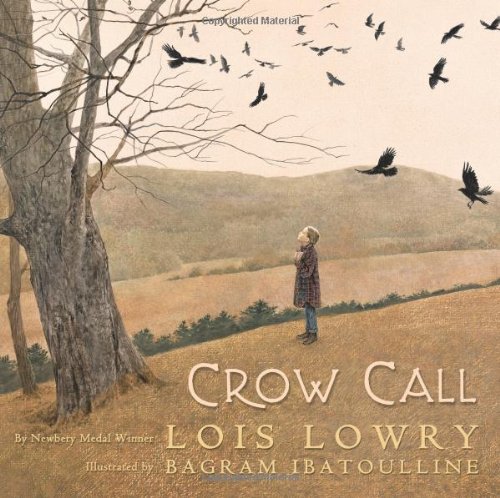
Crow Call

Lizzie's father has just returned home after fighting overseas in WWII for longer than she can remember.  This story shows the beginning steps in rekindling their strained relationship.  Though Lizzie is excited to spend the day with her father, she's shy: "I practice saying his name to myself, whispering it under my breath.  Daddy.  Daddy.  Saying it feels new."

Probably feeling a little unsure himself Daddy selects a gift that is symbolic - something his young daughter will never outgrow.  His concrete, outward gift is a man's flannel shirt that Lizzie can wear through the years as she goes out into the wilderness, building memories with her dad.  The deeper gift, though, is his explicit commitment that he will be present there with her, taking special outings as she continues to grow.

As they head through the gray green hills of the Pennsylvania farmlands to call crows from the silent sky, intending to shoot them, a poignant conversation bubbles up.  The gun, and the thought of her veteran father being both a hunter of men and hunted by men, awaken many of the fears in young Lizzie.  She shyly but honestly initiates a conversation about their shared fears, fear imparted through the legacy of war.  Realizing Lizzie is still scared of guns and has a soft heart for the crows, Daddy elects not to shoot any.  Instead they just call them up and watch them fly peacefully away as they walk peacefully away, hand in hand.

To extend the themes of this book, we watched a short video showing real life reunions between veterans and those they've left behind.  We also read historical documents - letters written from those on the front lines - to their loved ones at home.  These letters and the video revealed the deep love, longing, and fears that transcended the distance separating loved ones during war.       


Links:

https://www.youtube.com/watch?v=nEecPOyKGKc&app=desktop
http://veterans.heraldtribune.com/2014/07/10/world-war-ii-childs-eyes/
http://dearmotheranddad.typepad.com/
http://www.thejucketts.com/civilwar/december271861.htm
http://www.thejucketts.com/civilwar/june111861.htm

Tuesday, November 11, 2014

The Wall

On November 11, we honor the wartime sacrifices of men and women in our armed forces.  Originally termed Armistice Day to commemorate the Armistice that brought an end to WWI, it was renamed Veteran's Day to honor the veterans of all American wars.

In this sobering story, a young boy visits "grandfather's wall," the Vietnam Veterans Memorial, with his father to look for his grandfather's name.  This monument chronologically lists the names of more than 58,000 Americans who gave their lives in this controversial war.  Seen through the eyes of a child, this touching story is an age-appropriate introduction to new generations about the sacrifices that military veterans have made and the impact these sacrifices have had on families.  The book invites us to share the boy's curiosity, prompting questions of readers about the wheelchair bound soldier with no legs, the grandma and grandpa tearfully embracing, the many flowers and mementoes left behind, and the teacher 's suggestion that the wall belongs to all of us.

As extensions, we looked at the Library of Congress archives where the memories of thousands of veterans have been recorded through correspondence, photographs, diaries, and memoirs.


Finally, as a way to honor our veterans who have protected and sacrificed for us, we educated ourselves about the plights that many veterans are still facing.  Sadly, after sacrificing so much overseas, many veterans return either visibly injured or with Post-Traumatic Stress Disorder (PTSD).  Resultantly, close to 40% of our nation's homeless are veterans, and those numbers are expected to rise.  We read about efforts such as Stand Down and the VA's plan to end veteran homelessness.  Honoring our veterans is more than feeling a swelling of patriotic pride as we safely salute the flag or attend a parade as we see veterans marching by in military pomp.  Just as veterans fought for us, so too, many now need us to fight for them.  Our veterans are worthy of nothing less.


.                                       


Links:
http://www.nps.gov/vive/index.htm
http://www.loc.gov/vets/stories/wwi-diaries-memoirs.html
http://www.scholastic.com/browse/article.jsp?id=3755254
http://en.wikipedia.org/wiki/National_Coalition_for_Homeless_Veterans
http://vvsd.net/success.htm

http://www.theguardian.com/world/2012/sep/18/vietnam-unexploded-landmines-bombs
http://www.nbcnews.com/id/32236846/ns/world_news-asia_pacific/t/vietnam-land-mines-still-line-million-acres/#.VHykVIeLYug


Wednesday, November 5, 2014

Testing the Ice

Written by the daughter of baseball legend, Jackie Robinson, Testing the Ice tells the story of how Jackie Robinson routinely put himself in danger to "test the ice" for others, making sure that they could safely go about their lives.  He did this most famously by breaking the race barrier, integrating Major League Baseball.

This famous story is retold in part.  One day, Dodgers General Manager, Branch Rickey, approached Robinson, with an offer to join the team.  Rickey warned Jackie that integrating into MLB would require a lot of determination, long suffering, and courage.  These things he had.  Sharon Robinson rehearses the well known manifestation of these virtues (his MLB career), but then tells a heartwarming true story of how Jackie displayed these same character traits as a watchful father.

This story is set, decades removed from Jackie's early baseball career.  Jackie's children gather with friends (both black and white) at their comfortable lake house, listening wide eyed to stories of this walking legend.  The children regularly bounce from Jackie's trophy room to playing in the lake.  Jackie never joins them because he doesn't know how to swim and is scared of the water.  One winter day, the children beg to go out and skate on the ice.  Wanting to ensure that they are safe, a much heavier Jackie ventures out carefully onto the ice, testing its strength, putting himself in danger to make sure that others are safe.

Not only does Sharon Robinson share a beautiful childhood memory, but she creates a wonderful metaphor for breaking the color barrier. As she said in an interview on National Public Radio, "[This story] so perfectly defines Jackie Robinson the athlete, Jackie Robinson the husband, the father, the loving, the courageous, the caring... I wanted children to understand the totality of this man and how consistent he was in both his public persona and his personal one."


Links:

https://www.youtube.com/watch?feature=related&v=hCBoskYx3Is&app=desktop
http://atyourlibrary.org/sports/author-sharon-robinson-champions-legacy-her-father-jackie
http://www.sharonrobinsonink.com/books/
http://www.sharonrobinsonink.com/media/

Tuesday, November 4, 2014

Freedom School, Yes!


http://d.gr-assets.com/books/1347234360l/1006507.jpg

Today we read a fictionalized account of events that took place during the 1964 Mississippi Summer Project.  During this time, Freedom Schools were set up as temporary, alternative free schools.  Part of Civil Rights efforts, they were meant to help African Americans achieve social, political, and economic equality.  More than 600 volunteers risked their lives to teach black children in the deep South "'bout people and places, 'bout who you are." 
In our story, Annie, a 19-year-old white teacher from up North, came to stay with Jolie and her family. When racist vandals throw a brick through Jolie’s bedroom window, she wishes the teacher would head home. Later arsonists burn down the church that had housed the Freedom School. Annie refuses to give up and holds the Freedom School under an old hickory tree.
 http://www.crmvet.org/crmpics/volpics/vol14.jpg
Through Jolie's young eyes, we were able to glimpse the frightening violence of the 1960s South and sense the need for rejecting all inherited ideas that might cause us to value any one person over another.

Just as this school affords Jolie the opportunity to learn about Jacob Lawrence, Countee Cullen, and Benjamin Banneker, students in our class had the opportunity to read about these figures.  During M.I.L time, students also had the opportunity to read about the history of Freedom Schools in the South and to read about a “Freedom School” still operating right here in the Twin Cities.

 http://www.crmvet.org/crmpics/fs2.jpg
http://www.usprisonculture.com/blog/wp-content/uploads/2013/02/freedommustbelived-e1359911374197.jpghttp://courses.education.illinois.edu/ci407ss/Freedom-School-Registration.jpg


In addition to talking about the historical/ social/ and political implications of this story, we followed our routine practice of charting out the story structure and discussing the author's unique language.  Here we explored
  • ways the author build up suspense in the story.   
  • how the author made us feel as Jolie was searching for Annie
We also situated the implications of our reading in the context of our specific class.  How are we similar to or different from the students in this story?
  • How can we help each other in class?  We talked about what it means to be brave and how it's sometimes scary to stand up to those who are mean.  In the words of Jolie’s uncle: “You gonna learn ‘bout people and places ‘bout who you are.  Once you learn that, you ain’t gonna let bein’ scared get in your way.”
  • We talked about how there were many brave whites in this story and throughout the South during the Civil Rights movement.  Color does not determine whether or not you will be prejudiced or whether or not you will be kind.  We each have the choice to determine whether we will love or whether we will treat others poorly, regardless of our color or other parts of our background.
After looking at some historical pictures of Freedom Schools we also listened to some of the original folk songs that were sung in this freedom movement:

http://www.folkways.si.edu/we-shall-overcome-songs-of-the-freedom-riders-and-the-sit-ins/african-american-music-american-history-historical-song-struggle-protest/album/smithsonian

                      “We Shall Overcome,” We Shall Not Be Moved,” “Oh Freedom.”
Student learning about this topic culminated in the following:  
Write: Remember all the background history you learned about Freedom Schools.  Use this and then use the characters and structure of this book to write newspaper articles explaining the events in this story as they occur.  Include interviews of some of the characters and other important background information.