In this book, Bunting takes on the difficult topic of sickness and eventual loss of a loved one. Like many of her books, this tale is based on a true story. In it, the young narrator's best friend, Rudi, is very ill. He loves to paint and draw and, though sick, he summons the strength to help the narrator paint her garden gate green with yellow tulips on it. Most of the time, though, Rudi and is confined to his bed; he can't go on nature walk with his friend and spends a lot of time in the hospital. Very understandably the narrator struggles with this. Eventually, Rudi dies and the narrator and her classmates respond by creating a pond on the school grounds under a big knobby oak tree to remember him by. Rudi loved hummingbirds and left behind a feeder he made. His friends hang this by the pond in memory of him. One day, a hummingbird comes to visit. The bird returns over and over. Then summer vacation comes. The little girl takes the hummingbird feeder home with her. She wonders if the hummingbird will be able to find her house. (It's never seen it before.) But as she places the feeder by her green gate - the one Rudi adorned with yellow tulips - gate, the story closes with the line "I think the hummingbird will remember." The implication is that Rudi's spirit and memory lives on in the hummingbird.
Theme: Death and loss; death is not the end.
Symbolism: Rudi's memory lives on in the happiness and color of the tiny hummingbird.
Friday, November 21, 2014
Thursday, November 20, 2014
Some Frog
Wednesday, November 19, 2014
Going Home
Here, a versatile Bunting explores the tough decisions that accompany a family's decision to migrate, showing that even though many wish to immigrate for greater opportunities, there is much left behind and much sacrificed so that new generations can have opportunities. Families, culture, and a sense of place are valuable things that many leave behind. Bunting also explores the deeper philosophical question, "What is home?"In the book, an immigrant family goes back home to Mexico to celebrate Christmas with their wider family. They originally made the difficult decision to immigrate to the United States, leaving behind loved ones and their sense of place, because they felt that it would give their children greater opportunities. As the children watch their parents dance in the streets of their hometown, they come to realize that Mexico is part of who they are and who their parents are. They realize the sacrifices their parents have made to carve out an opportunity at a better life for them.
"They love it here because it's home. They have left home for us."
We discussed whether home could be in two places. We also discussed sacrifices that our parents have made for us.
Each student made a Venn Diagram with two circles that overlap. In one circle, they described the concept of home described in Going Home. In the second circle, they put the concept of home described in Grandfather’s Journey. The circles should be overlapped, with the overlap including attributes of home that are shared in common by both books.
Tuesday, November 18, 2014
Sunshine Home
With this sensitive text, Bunting forces readers to puzzle over what truly constitutes love. Is it interacting with someone who has it all together in a setting that is to our liking, or is it being with someone "in sickness and in health," "in good times and in bad?"
By the end of the story, Timmie has revealed his real feelings and his fears to his parents. This honesty paves
the way for him accepting the true burden of love - cherishing someone, caring for them and sticking by them, even when it's not in your own self interest.
Theme: Love is... present in sickness and in health, in good times and in bad.
To extend this, we brainstormed how much care little babies need - they are helpless. Students read a short article about caring for little babies. We explored how this was much the same as caring for an old person. They have already given that care to their children. Now the gift of caring love is coming full circle.
Monday, November 17, 2014
Gleam and Glow
During the Bosnian War, cellist Vedran Smailovic plays Strauss inside the bombed-out National Library in Sarajevo, on September 12, 1992.
Theme: Look for beauty amidst the pain of life. In time, this beauty will blossom into signs of hope and renewal.
We spoke briefly about the historical backdrop of the Bosnian conflict, but rather than reading about this violent episode in our history, students had the opportunity to read about modern day refugee children.
Students read about problems of refugee populations around the world and human rights issues related to refugees.
Then students brainstormed a list of rights that they think all human beings should have. After conducting this brainstorm, we compared student lists to the list created under the Universal Declaration of Human Rights and the Convention on the Rights of the Child.
I distributed a list of refugees by continent. We saw that refugees exist on all populated continents, enabling learners to have a wider understanding of the basic human need for dignity that all refugees feel.
Finally, we talked briefly about South Africa's model for dealing with past wrongs - the celebrated Truth and Reconciliation Commission.
Links:
Bosnian conflict:
Refugees:
- http://learningtogive.org/lessons/unit189/lesson4_attachments/3.html
- http://learningtogive.org/lessons/unit189/lesson4_attachments/1.html
- http://learningtogive.org/lessons/unit189/lesson4_attachments/2.html
- http://www.viewsoftheworld.net/wp-content/uploads/2012/06/RefugeesMap2011-12.jpg
Truth and Reconciliation Commission:
Friday, November 14, 2014
Scarlet Stocking Spy
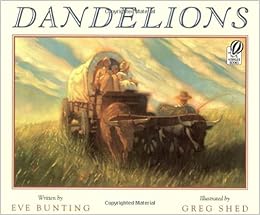
Dandelions
In this story, a pioneer father moves pregnant wife and family west from Minnesota, hoping for new opportunities and ready land. Loneliness and isolation set in right away. There are no trees and the grass closes behind them as they roll through miles upon miles in this sea of prairie. "It's as if we'd never been here", said Mama, forlornly. Their homestead site has no water, no flowers, no birds' song, and the nearest neighbors are three hours away. Papa reassures, "It will be different soon. Other settlers will come."
But as beetles and snakes plunge from the roof of their "soddie" onto their table, this far off hope was hard to imagine, especially for Mama and Zoe, the eldest daughter and narrator. Then one day as Papa and Zoe set off for supplies, they stumble upon a symbolic clump of dandelions, probably brought west by other settlers. They dig up a dandelion and transplant it on the roof of their sod house. Though the story ends with this transplanted clump looking dry and lifeless there is the expectant hope that like the seeds that lie latent, the family's life will soon bloom into color and happiness. But to get to this point it will take time. "Can you wait?" Zoe asked her mother... "I can wait," Mama said.
Though the closing words end in waiting hope, the last picture shows a hazy, dreamlike view of their farm in the future, dandelions covering the roof and the fields plowed and fertile.
Discussion:
Good things are worth waiting for and working for. Student writing focused on the ways that we wait and work patiently for the goods we pursue. Improving your reading, writing, math fluency, athletic skills, etc. all take a lot of work and patience. As we wait, we can find symbols of beauty and hope in simple, common things.
This was a great introduction to the challenges of the western movement and the lives of pioneers. To extend this learning, students read about life in sod houses.
Links:
http://amhistory.si.edu/ourstory/activities/sodhouse/more.html
http://www.nebraskastudies.org/0500/frameset_reset.html?http://www.nebraskastudies.org/0500/stories/0501_0109.html
Subscribe to:
Posts (Atom)