Monday, November 3, 2014

White Socks Only


http://d.gr-assets.com/books/1349038253l/961016.jpgOn a sizzling summer day in rural Mississippi, a little African American girl walks into town alone, hoping to learn whether it really is possible to fry an egg on the sidewalk.   As she heads home, she stops for a drink of water. Resting above the fountain is a sign that reads, “Whites Only.”  Having grown up in the country and without an adult with her, this lovely girl is delightfully naive to the reality of racism and segregation.  She assumes that the sign above the water fountain must refer to white socks.  Wanting to comply and follow this strange rule, child takes off her dusty leather shoes.  She has just begun to drink when an angry white man grabs her and pushes her to the ground. He threatens to "whup" her.  Before he can do this, however, the black townspeople come to the girl's rescue.  There is force in numbers, especially in this non-violent protest and assertion of human dignity.  Like the naive girl, these onlookers take off their shoes and drink from the same fountain.


https://blogger.googleusercontent.com/img/b/R29vZ2xl/AVvXsEjqrhWt3D7KuaURZWiaxP3LscHn7yHN2myYMHHa_qfZqOX28RIwv1WSd3aLXFekKV2OeQh6pR1QL-H9O034PNhz54LvgUPbE0tU5ynYspNfG1qbLNzQi4lGho1dXGBi5xDzPdURYM2RA2w/s1600/whites+only.gif  
Notice the grammatical error in this sign!  Love it!
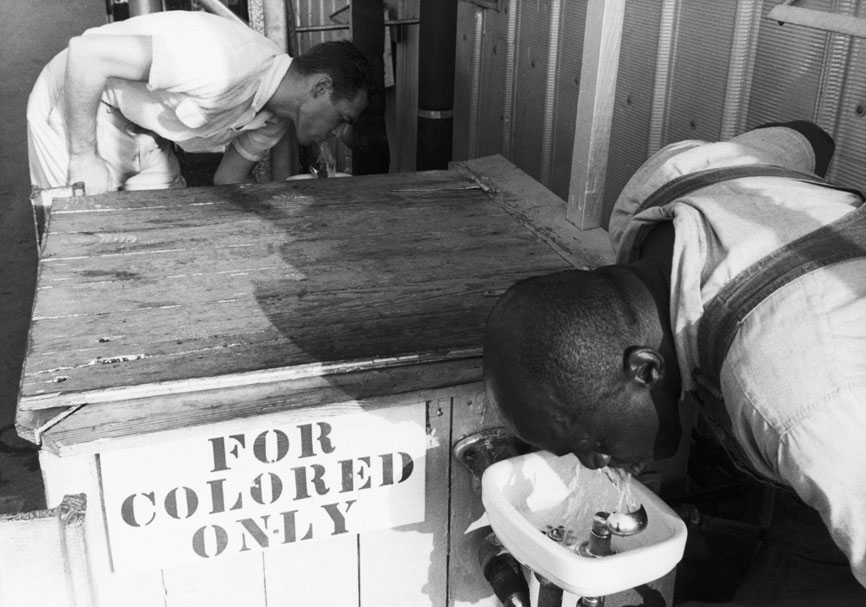

Instead of this:

https://blogger.googleusercontent.com/img/b/R29vZ2xl/AVvXsEipQfeTLGKZuK1ZIWqncXIpUdQUdlaK8mp7sPoI-Mo9x3luF8CD5NnceTEvY99p_FD41Z6hwyctTwdedqKzJDDsdDlfdMaW_QXvRC2EMlSQa4WWBwkPnAJMNNFIDYbhaC7o35kq_RqczQ/s1600/Colored%2520Only.jpg

This!

 http://www.graphics20.com/funny/wp-content/uploads/2013/02/No-Socks-Day-Graphics-7.jpg

Effectively the peaceful protestors in this book are saying it makes more sense to discriminate based on the color of socks than it does to discriminate based on the color of skin.  This said, though, all their socks are different colors.  Some have holes, etc.  The color of either skin or socks is ultimately irrelevant.  Humanity is comprised of a full rainbow of people, broken, ripped, and imperfect.

We discussed the community gathered around the water fountain - not just their physical appearances, but the powerful statement they were making, banding together in non-violent protest.  As an extension to today's reading, students read about some of the Jim Crow laws in the South and they also read about other historical movements that used non-violent protest.  They read about Gandhi in India and the non-violent tactics of Dr. Martin Luther King, Jr.

http://www.forumlive.net/proposte/legality/gandhi-non-violent-resistance.jpg
Write:
Write about a time that you were brave and stood up to those who didn’t extend respect to others.  Using some of the articles that describe non-violent protests throughout history, explain how peaceful resistance to "bullying" is the most effective strategy.

Friday, October 31, 2014

Real Life Zombies

The Name Jar

Guidelines for Philosophical Discussion
by Sarah Hopson
cited in full because it's awesome

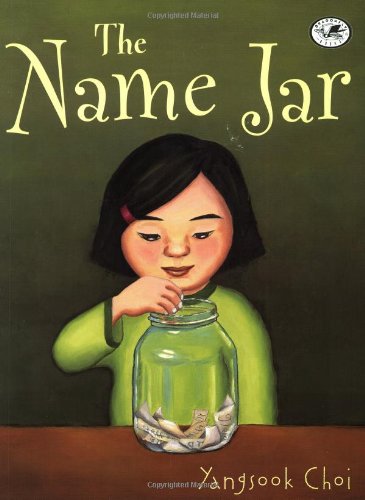
Throughout The Name Jar, questions about difference and identity underlie Unhei’s consideration of taking an American name rather than using her given Korean name at school. Is it good to be different or bad to be different? How do we respond to difference? Is a name just another word, or it is something more? How closely is one’s identity connected to one’s name? What are the implications of changing one’s name?

In terms of difference, today’s society strongly emphasizes tolerance in the form acceptance and often even celebration of difference. Despite this, division and alienation as a result of differences continue to arise. If we adopt an attitude of celebrating difference, can we go so far as to say that difference is always good? While it certainly seems beneficial to recognize, value, and appreciate difference in general, it doesn’t necessarily seem reasonable to simply accept certain ideological differences which lead to great pain and suffering. What then should be done? For some, it is enough to identify and understand the reasons for the difference or to promote conversation across the difference, while others claim that steps should be taken to minimize the difference. The Name Jar asks many of these questions in the context of Unhei’s difference from her peers, particularly in the form of her name, and thus provides an opening for discussion of how it feels to be different and the ways in which we should respond to difference in others.

As for identity, the term is generally used in philosophy to refer to whatever it is that makes an entity recognizable as distinct from others, in this case the set of characteristics that distinguishes one person from another. The Name Jar particularly addresses social identity, the way in which individuals define themselves in relation to others. This issue is seen in the story as Unhei changes the way in which she introduces herself to others depending on prior reactions and on the context of that point in the story: from saying her real name on the bus to claiming that she does not yet have a name when she meets her new class, from telling Mr. Kim her real name to sharing her name choice with her class. What is it about each situation that influences this behavior and what can this tell us about social identity? Themes that might emerge here include ways in which one’s identity is shaped by family and culture and the role of peers, family, and society in supporting or denying the development of one’s identity.


More specifically, The Name Jar encourages a consideration of assimilation, particularly cultural assimilation, one example of which is often the changing of one’s name. What does the choice to change one’s name entail and what significance does it have? Arguments in favor of name change for cultural reasons include having an easily pronounceable name, showing acceptance of the new culture, and minimizing difference, while arguments against include maintaining cultural identity, keeping family history and lineage alive, and retaining connections. The Name Jar shows Unhei experiencing many of these conflicting pressures: wanting to fit in with her new classmates and not be teased for her Korean name yet retaining strong ties to this name through her family culture and name stamp. Discussing these issues begins to address the question of what connection peoples’ names have with their identity and whether or not this connection is the same for everybody or not.

found at: http://www.teachingchildrenphilosophy.org/wiki/The_Name_Jar

Monday, October 27, 2014

My Name is Yoon

http://d.gr-assets.com/books/1316737622l/821292.jpgThis story illustrates the challenges that a newly immigrated Korean girl, Yoon, faces as she moves to America.  None of her classmates can pronounce her given name, a name which means "Shining Wisdom."  They chuckle.  To her aesthetic sensibilities (and mine), her name also looks much more appealing to her written in Korean than in it does in English.  It Korean it looks like dancing figures, or possibly a snowboarder.  In English it's just empty circles and lines.


    윤  vs Yoon

 Pressured to adopt the clunky Anglicization of her name, Yoon experiments with other names like "bird" and "cat" and "cupcake."  In the end, she comes to accept both her English name and her new American self, recognizing that however it is written, she is still Yoon

While this text was moderately simplistic, it opened up a valuable conversation, both philosophically, socially, and historically about the importance of our names and preserving a sense of one's own self identity.

Philosophically, we explored the meaning of names, borrowing from Juliet's famous question: "What's in a name?"

Historically, we explored Jewish naming customs and we looked at the history of forcible renaming that occurred in Native American boarding schools.  In an effort to Anglicize the young Native Americans, the U.S. Government forcibly took them from their parents, placing them in boarding schools.  They were forbidden from speaking their native languages, wearing native clothing, or using their given names.  They were forcibly assimiliated (or culturally changed).  Their identities were yanked out of their hands and changed.

This fact inspired us to talk about the value of preserving the elements we each possess that make us unique, rather than attempting to change ourselves to suit someone else's notion of what we should be.

Photo 1: Chiricahua Apache's from Geronimo's band as they arrived at a boarding school in 1887. Photo 2: 4 months later after the assimilation process began to take hold. 


Links:
http://www.economist.com/blogs/freeexchange/2014/03/names-and-wages
http://www.uscis.gov/history-and-genealogy/genealogy/genealogy-notebook/immigrant-name-changes
http://www.uscis.gov/sites/default/files/images/KohnovalskyCohn.jpg
http://www.uscis.gov/sites/default/files/images/ZakotskyShukowsky.jpg


Friday, October 24, 2014

Nasreen's Secret School


http://ecx.images-amazon.com/images/I/51cKB7Nh4YL._SX258_BO1,204,203,200_.jpg
This book helps to explain the drastic changes that occurred when the Taliban came to power in Afghanistan in 1996. Set in the backdrop of these true events, this story’s main focus is how the Taliban’s rule affected women and girls.  Following their takeover, Afghani females were no longer allowed to attend school or leave home without a male chaperone.  They had to cover their heads and bodies with a burqa

Little Nasreen's pain is deeper still.  Her parents mysteriously disappeared, sadly a somewhat common occurrence under Taliban rule.  Now, the child refused to draw, sing, smile, even speak. Longing to help, Nasreen's wise grandmother hears of a secret school  set up in defiance of the rigid Taliban  prohibitions.  Hoping to open her mind again to hope and purpose, the grandmother begins sending little Nasreen to the forbidden school.  This education slowly opens her eyes to the beautiful world of art, literature, and history, thus beginning Nasreen's road to healing.


http://cdn.theatlantic.com/static/mt/assets/international/Afghan%20kite%20flyer%20banner.png
After reading this text, students were given the same opportunity that so enlightened little Nasreen - the opportunity to learn about the richness of unknown worlds.  Students read about life in Afghanistan, looked at photos of its rich culture, beautiful landscape, and learned about its history.  They also read about the rich tradition of Afghan kite making.


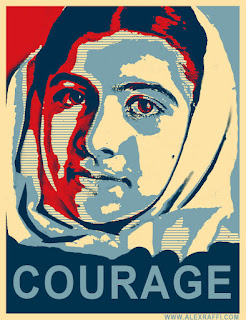
Finally, we read about the amazing life of Malala Yousafzai, a Pakistani activist for female education and, at 17, the youngest ever Nobel Prize recipient.  Both through lived experience and through compelling advocacy, she connects national - and global - security with the availability of education.

Another article, which we discussed in depth, makes this same case.  I offer the gist below:


In a nation of 170 million people – almost half of whom are under the age of 18 – only 50 per cent of Pakistani girls and 60 per cent of boys go to primary school, despite the fact that this schooling is entirely state funded.  In this country which now boasts a nuclear arsenal, it's estimated that half of the population is probably unable to even write their names.  Those unable to perform even this basic task are much easier to control and to be duped into accepting radical militant Islam.

Links:

Thursday, October 23, 2014

The Librarian of Basra

In this true story emerging from war town Iraq, we are given a valuable alternative vision of what it means to be a faithful Muslim.  Over time, the sensationalized treatment each and every suicide bombing gets from our media begins to impart misplaced caricatures.  This true hero, Alia Muhammad Baker utters the lines that led her life's faith-based work: "In the Koran, the first thin God said to Muhammad was, 'Read.'"

War clouds threatened on the horizon, and Alia Muhammad Baker, chief librarian of Basra's Central Library, refused to let these books, "more precious than mountains of gold" be destroyed.  After being denied help from the government, Alia moved the library's holdings to a nearby restaurant just nine days before the library was torched.  As fighting continued, she risked personal safety to smuggle over 30,000 volumes to her home and the homes of friends.


Then, Alia waits.  Like so many Iraqis today, tired of war and ready for peace she waits. She waits for a new library to house her collection of books.  The book ends with this goal unrealized.  The fighting in Iraq continues in the midst of American occupation.  Sadly, nearly ten years after publication, little has changed.