Wednesday, February 25, 2015

Ecosystems Research Project


Ecosystem Research Project


General Guidelines:
·      You will create either a nonfiction book or power point presentation in which your research will be displayed. There will be a page for each ecosystem.
·      You will be collecting information about the following ecosystems: Forest (coniferous/deciduous), Rainforest, Oceans, Rivers, Ponds/Lakes, Salt Marsh/Estuary, Grassland, Desert, Tundra
·      You will use the ecosystem research project note sheets provided to record your information and will turn these in as part of your grade.
·      Your book must include all required information requested on the notes sheet, including pictures.
·      You will be graded using the rubric attached to this packet.  See each category for specific details.
·     You must hand in this packet along with your completed project.
·      You will be given enough time in school to finish this project. However, if you don’t use your time wisely, you will need to take this project home to complete.

Suggested Websites:

Other Helpful Websites
Estuaries/Salt Marshes:
Oceans:
            
Lakes/Ponds:

Grasslands:
              
 Forests:


Tuesday, December 2, 2014

One Candle


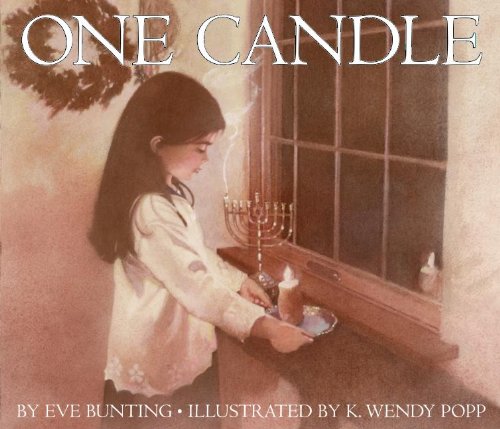
Amidst the food and festivities of Hanukah adorning a comfortable modern holiday table, two elderly women - Grandma and Great Aunt Rose - begin to tell a story explaining their non-traditional choice for commemorative Hanukah menorahs (candles).  When these women were but girls - 12 years old - they were confined to a brutal Nazi concentration camp, Buchenwald.  Here, they worked in the kitchen.  Risking great danger, they carefully smuggled out some butter and a potato.  Though literally starving, they did not eat these items, but rather, used them along with a string from their skirt, to improvise a candle to commemorate Hanukkah.

Asked why they took this huge risk, grandmother replies,

"That Hanukkah candle lifted us.  It lifted us to the stars.  In our minds, sweetheart.  In our hearts."

As they retell this story year after year, lighting their potato candle, we readers are also lifted to the stars.  With these two small girls, Bunting gives a powerful story of defiant triumph over evil, of brave clinging to hope in the midst of despair.  Tellingly, Bunting ends her story with a repetition of those powerful lines,"And in that moment we are lifted to the stars."


Theme: Remember - renarrate - history's stories of defiant triumphs of unassuming weakness over evil, of brave clinging to hope in the midst of despair.

                               ______________________________________________

My extension: comparing Bunting's story to (an even more beautiful) story I heard once several years ago:

Perhaps Bunting borrowed this story from the real life story of Rabbi Hugo Gryn.  I researched it and could find no intentional connection.  

At any rate, when Hugo Gryn was a child in Auschwitz with his father, they saved their meager daily ration of margarine.  They were slowly starving to death and young Hugo argued with his father, demanding that they eat this, their only source of nourishment.  His father was already sick and weak, and a hungry young Hugo was appalled when he got the answer from his father.  They wouldn't eat the margarine.  They would make a Hanukah candle from it.

Hugo  just couldn’t comprehend his father's logic.  He told his father that it seemed foolish to do so, but his father melted the precious margarine ration to light a Hanukkah candle. Hugo protested. His father said, 

“My child, we know you can live three days without water. You can live three weeks without food. But you cannot live for three minutes without hope.” Live in hope. 


His father died when the liberation took place.  Not having enough physical food he starved to death.  But he starved to death living in hope.  He fed his spirit rather than his stomach, planting a seed of hope in his son who later became a world renown rabbi and advocate of peace and, despite the grave injustices that he had personally suffered, forgiveness.  


Links:
http://www.hugogryn.com/about-hugo-gryn/

Monday, December 1, 2014

So Far from the Sea

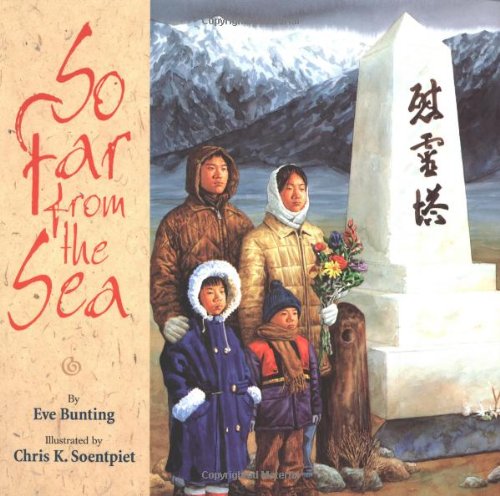
This story is told through the eyes of nine year old Laura Iwasaki who is going to visit her grandfather's barren grave one last time before the family moves out of the area.  This grave is located in the abandoned Manzanar Relocation Camp, one of ten relocation camps scattered across the West Coast to confine (or intern) Japanese Americans during WWII.   Here, the children's grandfather, a devoted tuna fisherman, was robbed of his boat, home and dignity, and sent to a land "so far from the sea."  There he died, burial marked only by a small ring of stones.  The family leaves silk flowers.  Laura leaves a poignantly tragic memorial, the neckerchief from her father's Cub Scout uniform, an article which the grandfather insisted his son wear if the soldiers were to come to their house, "that way they will know that you are a true American and they will not take you."

This neckerchief, a sign of the grandfather's sense of American patriotism that was ignored through misguided fear, symbolizes the general patriotism that filled the Japanese American community in the 1940's.

Before I continue, I acknowledge that this - like many of Buntings' stories - was a difficult story, touching on raw nerves in our country's long and murky blurring between justified "security" response and outright victimizing.  However, I firmly believe that preparation for voting citizenry comes through exposure to debates and opposing sides of an issue, looking at history in all its murkiness and, sometimes ugliness.  Bunting helps us to do just this.

To help put this weighing of the issue into action, students explored both sides - the official stance adopted by the U.S. government following Japan’s unprovoked bombing of Pearl Harbor and the Japanese American perspective and pain felt by many innocent civilian confined to interment camps.  We explored reasons why the Japanese might have been resented.  Granted, Pearl Harbor lay on the immediate backdrop and many feared that those of Japanese ancestry, second or third generation immigrants, might be traitorous.  Interestingly, these same fears were not in place for those of German or Italian ancestry.   Consider, too, the following quote:

  • "Most of the 110,000 persons removed for reasons of 'national security' were school-age children, infants and young adults not yet of voting age." 
    • "Years of Infamy", Michi Weglyn


Internment was popular among many white farmers who resented the Japanese American farmers and saw imprisonment as a convenient way of getting rid of unwanted competition.

Austin E. Anson, managing secretary of the Salinas Vegetable Grower-Shipper Association, told the Saturday Evening Post in 1942:
  • "We're charged with wanting to get rid of the Japs for selfish reasons. We do. It's a question of whether the white man lives on the Pacific Coast or the brown men. They came into this valley to work, and they stayed to take over... If all the Japs were removed tomorrow, we'd never miss them in two weeks, because the white farmers can take over and produce everything the Jap grows. And we do not want them back when the war ends, either."

WRA Relocation Centers
NameStateOpenedMax. Pop'n
ManzanarCaliforniaMarch 194210,046
Tule LakeCaliforniaMay 194218,789
PostonArizonaMay 194217,814
Gila RiverArizonaJuly 194213,348
GranadaColoradoAugust 19427,318
Heart MountainWyomingAugust 194210,767
MinidokaIdahoAugust 19429,397
TopazUtahSeptember 19428,130
RohwerArkansasSeptember 19428,475
JeromeArkansasOctober 19428,497

To heighten students' historical empathy I asked them to imagine that they were all Japanese-Americans and that they have found out they are going to be relocated.  The government is going to house everyone, but they cannot leave their possessions; they must sell or rent everything they have.  Only a few clothes and precious things can be kept. What would you take?


Links:
https://www.teachervision.com/tv/printables/beyondblame21_27.pdf
http://en.wikipedia.org/wiki/Internment_of_Japanese_Americans
http://www.sfmuseum.org/hist8/evac16.html
http://www.pbs.org/childofcamp/history/timeline.html


Tuesday, November 25, 2014

My Life as a Turkey

Some of you might be wondering why your children have sworn off turkey for the rest of their lives.  It's my fault.


As part of our Thanksgiving festivities, we watched this delightful, award-winning video about how wildlife aficionado, Joe Hutto raised a group of wild turkeys from hatchlings to adulthood.


Hutto obtained a bowl of unhatched turkey eggs and carefully "imprinted" the young birds.  As they incubated they heard the loving clucks of their unusual but dedicated "mother."  Finally, upon emerging from their shells, they locked eyes with this man who would sacrifice all vestiges of a human life to life as a turkey for the next year.  He reflects on his learnings - both practical and even philosophical - as he led these birds through walks in the Florida woods.  We come to know and love the various birds as characters in a movie.


Links:

http://trib.com/news/state-and-regional/wyoming-naturalist-reflects-on-experience-as-a-parent-to-wild/article_ed01418a-ee9c-5e72-8399-120d460ad9fd.html

Watch:

http://www.pbs.org/wnet/nature/my-life-as-a-turkey-full-episode/7378/

How Many Days to America? A Thanksgiving Story

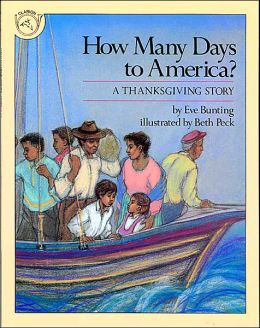
http://img2.imagesbn.com/p/9780395547779_p0_v1_s260x420.jpgAfter soldiers come, a family is forced to flee their Caribbean island home and sail across dangerous waters to America in a small fishing boat.  They faced hunger, were robbed by opportunistic pirates, and nearly capsized, all because they were drawn forward by the freedom they sensed could be found in America.

As they approach land, they spot soldiers.  In fear, they worry that the soldiers will capture them and deport them.  However, rather than following standard protocol, the soldiers bring the needy, hungry immigrants food and they allow them to stay rather than be deported.  The narrative key: it is Thanksgiving Day.

Bunting is doing something special here.  Rather than presenting readers with a realistic story of how immigrants are now treated by our "justice" system, Bunting uses fiction to expose our nation's inconsistencies of immigration narratives.  America's quintessential immigrants - the Pilgrims - serve as the unstated archetype for these immigrants.  They, like these Latin American immigrants, fled their homelands because of persecution.  Risking grave danger, both groups pressed forward to the perceived shores of freedom.


http://comminfo.rutgers.edu/professional-development/childlit/images/boat.jpg

Instead of deporting the Latin American pilgrims (imagine the jarring element if the original custodians of our land - the Native Americans - had attempted to deport us!), the soldiers strangely live the logic of "America's" founding narrative.  They offer hospitality, shelter, and food to those coming onto their shores.
http://upload.wikimedia.org/wikipedia/commons/6/6e/The_First_Thanksgiving_cph.3g04961.jpg

This book served as a valuable reference point, not only as we reexamined our nation's Thanksgiving narrative, but as we explored how we can better live this out.  Whether our families came to America ten days ago, ten months ago, ten years ago, or much longer than that, they, like most Americans, are either immigrants or descendants of immigrants.  They deserve the same hospitality that we celebrate this Thanksgiving.


http://i.huffpost.com/gen/313302/thumbs/r-OBAMA-IMMIGRATION-DEPORTATION-RECORD-large570.jpg


                   http://static2.businessinsider.com/image/4f58f96069bedd253c00005c/this-nasty-scam-causes-would-be-legal-immigrants-to-get-deported.jpg

However, there are inconsistencies.  And this story helps us to explore this.  We used this opportunity to talk about one of the hot issues in today's political sphere - immigration reform.

               _     __http://thinkprogress.org/wp-content/uploads/2006/04/foximmigrant.jpg_______________________________________________________

As students listened to the story they made Venn Diagrams comparing these "Thanksgiving" immigrants with those of Pilgrim lore.

We examined:
  • What prompted both groups to flee their homelands?
  • Where they able to take many things with them?
  • How did both groups view America?
  • Compare and contrast their voyages.  Were they dangerous?  How so?  What other hardships were faced?
  • How does food - its lack and the sharing of what is available - figure into both stories?
  • How did the original Pilgrims react when they first saw land?  How did the "pilgrims" from Latin America react?
  • Do you think Bunting's suggestion that the family can stay even after they are captured by soldiers is realistic? 
As further extensions we explored Nativism, looking at historical photos over the course of American history that depict this exclusionary sentiment.  We also read the immigration narratives of several immigrants - Russians, Scandinavians, and Hispanics.  Finally, we looked briefly at the rich variety of foods that immigrants have introduced to our diet.  This added richness is symbolic of the many new "flavors" that diversity brings to life.

You, whoever you are!...
All you continentals of Asia, Africa, Europe, Australia, indifferent of place!
All you on the numberless islands of the archipelagoes of the sea!
All you of centuries hence when you listen to me!
All you each and everywhere whom I specify not, but include just the same!
Health to you! good will to you all, from me and America sent!
Each of us is inevitable,
Each of us is limitless—each of us with his or her right upon the earth,
Each of us allow'd the eternal purports of the earth,
Each of us here as divinely as any is here.

  • Walt Whitman


Monday, November 24, 2014

We Shall Remain: After the Mayflower


http://www-tc.pbs.org/wgbh/amex/weshallremain/img/press/full/AftertheMayflower.jpgPart of PBS’s award winning documentary series – American Experience – we watched this video to learn the true contours of the relationship between the Pilgrims and the Wampanoag, the “Indian” tribe that offered them early assistance.  In many ways, this video took the myth we’ve often heard of the First Thanksgiving and turned it upside down, suggesting instead a history of cruelty and power that both Native and Colonist participated in.

http://www-tc.pbs.org/wgbh/amex/weshallremain/img/maps/WSR_show1_map_1.jpg                             In 1621, Wampanoag leader Massasoit negotiates to provide help to the ailing Pilgrims from the Mayflower.  Hungry, dirty and sick, the pale-skinned foreigners were struggling to stay alive; they were in desperate need of Native help. Massasoit faced problems of his own. His people had lately been decimated by unexplained sickness, leaving them vulnerable to their native enemies, the Narragansett to the west.  Massasoit negotiates, forming an alliance, because he thinks this alliance will ensure protection for his tribe from their enemies. Over the next fifty years, it becomes more and more clear that Massasoit was wrong.  The English continue to immigrate in greater and greater numbers, demanding more of the land, overusing and altering its bounty, forcibly converting Natives to Christianity, and threatening to swallow up Native identity.    

These pressures finally push the Wampanoag and the Pilgrims to war lead by Metacomet, Massoit’s son.  Known to the English as "King Philip," this war, King Philip's War, was the deadliest war, per capita, that America has ever seen.  Within little more than a year, twelve of the region's Colonial towns were utterly destroyed, many more damaged.  One tenth of all Colonial men were killed.  Many more Indians were killed.

http://raglinen.com/wp-content/uploads/2010/04/kingphilips600.jpg
 

A Day's Work

http://ecx.images-amazon.com/images/I/51hd0ElIueL._SX258_BO1,204,203,200_.jpgIn this wonderful book which so adeptly integrates moral truth with a believable and thought provoking story, a young Fransisco waits expectantly with his grandfather, Abuelo, and other day laborers, hoping for a day's work.  Abuelo does not speak English so Fransisco serves as an interpreter.  Desperately needing money to attend to daily needs like food, Fransisco tells a potential employer that his grandfather is a gardener, even though he's actually a carpenter.   What harm could come from this little white lie?  They're still willing to put in a hard day's work for very little return. Lacking this claimed expertise, though, Fransisco and his grandfather inadvertently pull out the plantings rather than the weeds.  After Fransisco's lie is discovered, Abuelo takes ownership for it, showing Fransisco the value of integrity at all costs.  "We do not lie for work."  Abuelo insists on correcting their mistake for no extra pay.

Grandfather's deeply guarded sense of honor illustrates that even the "lowest" labor carries dignity and honor when pursued with a good moral compass.  In fact no job can be viewed with respect unless it is carried out honestly.  While some jobs may yield different salaries, if carried out honestly, all yield the same ultimate good - self respect.

The story served as a valuable conversation partner as we discussed "intrinsic" and "extrinsic" motivations that lay behind all our decisions, whether in the classroom, at home, or in our communities.  Do we pursue our daily tasks - learning, for example - simply because of external factors (grades, not getting in trouble, allowances, etc.) or do we pursue learning and chores because of how they will improve us internally?  Do we make the right decisions even when those decisions hurt, or do we take the easy way out?  As in this story, though it may sometimes require sacrifice, creating habits of consistently acting honestly eventually yields good results. Because Abuelo insisted on being honest, they lost a day's wage, but earned the respect of their employer as well as an ongoing contract.
http://blogs.ocweekly.com/navelgazing/Let-Laborers-Live.jpg                                http://images.sodahead.com/polls/000268049/polls_DayLaborPick_UpSite_4901_878493_poll_xlarge.jpeg
For extensions we looked at the true stories and challenges facing  many day laborers in our country.

Links:
http://nfwm.org/farm-worker-stories/
http://www.calisphere.universityofcalifornia.edu/calcultures/ethnic_groups/subtopic3b.html